Baby Dahlia Script Font for Elegant Branding
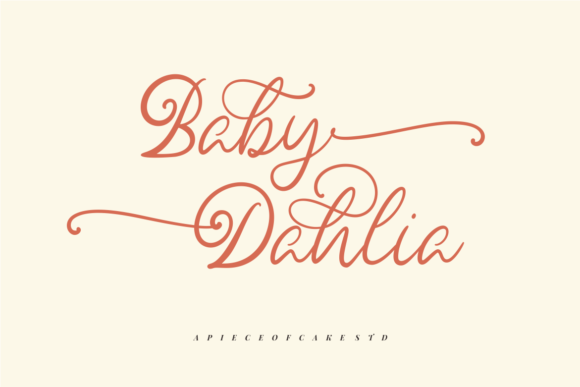
I opened a blank brand board last week for a local ceramicist launching her first small-batch tableware line — soft glazes, hand-thrown forms, quiet luxury. She’d asked for something “warm but refined,” no corporate stiffness, nothing too trendy. I dropped in Baby Dahlia on the logo draft before even sketching alternatives. Instantly, it felt like exhaling. Not because it’s flashy or loud, but because Baby Dahlia is a magical script font carefully created with a touch of elegance — and that elegance lands differently when you’re holding actual packaging mockups in your hands, not just scrolling previews.
Baby Dahlia for Wedding Invitations and Elegant Branding
Baby Dahlia lives in the sweet spot between calligraphic precision and gentle human imperfection — a true Script Handwritten typeface that breathes without wobbling. On wedding stationery (tested on cotton-finish invites and foil-stamped belly bands), its tapered entry strokes and subtle exit swashes give rhythm to names and dates without sacrificing legibility at 14–16pt. It’s not overly ornate like Victorian scripts, nor so minimal it reads as generic brush lettering. As a Fonts choice for high-touch, low-volume print work — think boutique bridal studios, artisan florists, or independent calligraphers offering digital files — Baby Dahlia delivers quiet authority. It doesn’t shout “romance”; it whispers “intention.”
Baby Dahlia for Instagram Captions and Social Media Graphics
Here’s where Baby Dahlia surprised me most: Instagram. I used it for a carousel header (“Handmade with Care”) over a neutral linen background — not as a full sentence, but as a single-line accent. At 36–48px on mobile, the spacing holds, the curves stay crisp, and the contrast against clean sans serifs (I paired it with Montserrat Light) creates instant visual hierarchy. As a Script Handwritten font built for screen use, it avoids the pixelation or blurriness some delicate scripts suffer at smaller sizes. That said: skip long captions or bio text. Baby Dahlia shines as a display font, not body copy. Use it for quotes, feature headers, story highlights, or branded quote cards — never for paragraphs or dense CTAs.
Baby Dahlia for DIY Projects and Handmade Shop Branding
If you're sourcing Fonts for Etsy shop banners, printable wall art, or craft fair signage, Baby Dahlia earns its “magical” label through versatility. I tested it on kraft paper product tags (with a muted sage ink simulation) and laser-cut wood signs — both times, its modest x-height and open counters kept it readable under natural light. Its Script Handwritten character reads as personal, not mass-produced, which matters when selling handmade goods. Bonus: the included stylistic alternates (like the lifted ‘t’ and looping ‘y’) let you subtly rotate versions across social posts or packaging variants — a low-effort way to add visual texture without design fatigue.
Baby Dahlia for Logo Design and Packaging Labels
For logos? Yes — but with boundaries. Baby Dahlia works beautifully as a *secondary* logotype (e.g., tagline beneath a strong geometric mark) or as the sole wordmark for brands with inherently soft, tactile, or feminine-leaning positioning — think apothecary labels, botanical tea blends, or slow-fashion studios. I placed it on a matte-finish ceramic mug mockup: elegant, yes — but only at 24pt+ with generous letter-spacing. At tiny sizes (under 18pt on physical labels), the fine hairlines begin to close up, especially on uncoated stock. So if your packaging includes small ingredient lists or legal disclaimers, pair Baby Dahlia with a highly legible sans serif (think Inter or Lora) for supporting text. And always test print — screen rendering flatters subtlety; press runs don’t.
Baby Dahlia Font Pairing and Practical Licensing Notes
My go-to pairing? Baby Dahlia + a warm, low-contrast serif like Playfair Display (for editorial depth) or a neutral humanist sans like Poppins (for modern balance). Avoid competing scripts — two handwritten fonts cancel each other’s charm. Also: check what’s included. The Fonts package offers OpenType features — ligatures, contextual alternates, and discretionary swashes — but no bold weight or italics. It’s one style, designed intentionally as a singular voice. That’s a strength, not a gap — unless your project demands heavy typographic contrast. Finally, a non-negotiable: verify commercial licensing. Baby Dahlia is licensed for use in client branding, packaging, websites, and digital products — but always confirm whether webfont embedding, template resale, or merchandise printing is covered. Most reputable vendors include clear license tiers; don’t assume.
In short: Baby Dahlia isn’t a Swiss Army knife. It’s a well-honed chisel — precise, graceful, and quietly powerful when applied with care. If your work values warmth, tactility, and understated refinement — and you need a Script Handwritten font that performs across print, web, and social without feeling dated or saccharine — this is one of those rare Fonts that earns its place in your core toolkit.