Vintage Love: A Handwritten Script Font for Warm, Clear Campaign Messaging
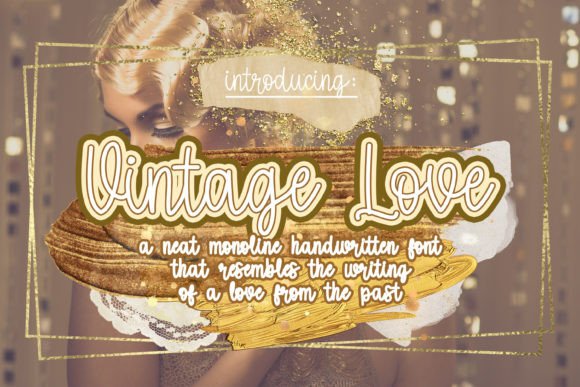
It was 3 p.m. on a Tuesday — and I was squinting at a YouTube thumbnail preview on my phone. The headline read “Spring Collection Launch,” but it felt flat. Too generic. Too safe. The sans serif font blurred into the background, and the emotional hook — soft romance, handmade charm, quiet nostalgia — wasn’t landing. That’s when I opened my fonts folder, scrolled past the usual suspects, and clicked Vintage Love. Instantly, the mood shifted. Not because it’s flashy or trendy — but because Vintage Love is a handwritten script font that carries warmth like a well-worn love letter.
Vintage Love for Wedding Invitations and Elegant Branding
Vintage Love isn’t just another freebie font — it’s one of those rare Freebies that behaves like a premium typeface. Its letters flow with gentle, intentional swoops — especially in lowercase s, y, and f — giving every word a tender, classic rhythm. When I used it for a boutique florist’s wedding invitation suite, the script didn’t compete with the imagery; it whispered alongside it. Paired with a clean serif like Playfair Display for body text, Vintage Love became the emotional anchor — not decorative filler. It works best for short, meaningful phrases: “Forever Begins Here,” “Join Us,” “Handpicked Just For You.” As a display font, it’s never overwhelming — just unmistakably human.
Vintage Love for Instagram Story Covers and Reels Titles
Scrolling through Instagram Stories? You’ve got ~1.5 seconds to register tone before someone swipes. That’s why Vintage Love shines in vertical, fast-moving formats. Its “classically neat” structure — not overly ornate, not too casual — ensures legibility even at small sizes. I tested it over soft pastel gradients and textured linen overlays (common in lifestyle brand Stories), and it held up beautifully. No pixelation, no awkward spacing — just confident, romantic clarity. As one of the most thoughtfully crafted Fonts in the Freebies category, it includes basic OpenType features like standard ligatures and alternate characters — enough to add subtle polish without needing design software mastery.
Vintage Love for Pinterest Quote Pins and Branded Content Series
Pinterest is where intention meets aesthetics — and Vintage Love fits right in. When building a 12-part “Slow Living Tips” content series, I used Vintage Love exclusively for quote headlines (“Breathe Deeply,” “Make Time for Tea”) layered over muted botanical photography. Its vintage love feel — soft curves, balanced x-height, graceful ascenders — created instant cohesion across dozens of pins. Crucially, it remained readable on both mobile thumbnails and desktop grid views. Unlike many script fonts, Vintage Love avoids tight kerning traps or fragile terminals — meaning your message stays intact, even when compressed into a 200px-wide pin.
Vintage Love for Email Banners and Online Shop Promotions
Email banners live in a tricky space: they need personality *and* scannability. I dropped Vintage Love into a limited-time offer banner (“24 Hours Only — Handcrafted With Love”) for an online ceramics shop. The font’s natural rhythm slowed the eye just enough — encouraging pause, not confusion. On light backgrounds, it glowed. On dark navy overlays, it stayed crisp (I boosted contrast slightly in editing, but no heavy outlining needed). As a handwritten script font, it’s ideal for short, emotionally resonant labels — not long paragraphs. Think: “New Arrivals,” “Just Restocked,” “You’re Invited.” It signals care, craft, and continuity — exactly what handmade and small-batch brands want to project.
Vintage Love for YouTube Thumbnails and Digital Ad Headlines
Here’s the real test: Does Vintage Love survive the YouTube thumbnail gauntlet? Yes — but with smart usage. I used it only for the primary headline (“Love Letters, Not Algorithms”), sized large and centered over a softly blurred vintage desk photo. No subheadings, no secondary text in the same font — just one strong phrase, perfectly spaced. Its “swooping action” adds movement without sacrificing stability, and its moderate contrast keeps it visible against busy backgrounds. For digital ads, I paired it with Montserrat Bold for supporting copy — a classic font pairing that balances warmth and clarity. And yes — this Fonts file supports commercial use, so no licensing panic before uploading to Meta or Google Ads.
Vintage Love for Landing Page Headers and Branded Templates
When designing a lead magnet landing page for a journaling course, I needed typography that said “thoughtful,” “inviting,” and “timeless” — all in one glance. Vintage Love delivered. Set at 64px over a cream background with generous line height, it became the first thing visitors noticed — not as decoration, but as tone-setting language. It’s not a workhorse font, and it shouldn’t be. Use it where you want attention, emotion, and recognition — not for navigation menus or dense feature lists. As part of a broader modern typography system, Vintage Love elevates everything around it. Bonus: it’s available in OTF and TTF formats, fully compatible with Canva, Figma, and Adobe Creative Cloud — no font substitution surprises.
How to Use Vintage Love Without Overdoing It
- Stick to 1–2 lines max — it’s a display font, not a paragraph font.
- Always pair with high-contrast sans serif or serif (e.g., Inter, Lora, Poppins) for body text and CTAs.
- Test on mobile first — zoom in on thumbnails, Stories, and email previews before finalizing.
- Avoid dark-on-dark or light-on-light combos unless you manually adjust brightness/contrast.
- Check included glyphs — this version supports Latin-based languages and common punctuation, but no extended diacritics.
If your next campaign needs more heart, more clarity, and less visual noise — Vintage Love isn’t just another freebie. It’s a strategic handwritten script font that helps your message land with feeling, not force. And since it’s among the most refined Freebies in the Fonts category, there’s zero risk in trying it on your next Instagram post, email header, or product launch graphic. Just open the file, type something true — and let the swoop do the rest.